

Into the slings at the haul-out.
After a couple of weeks of trying not to get too excited, survey day finally came. If all went well, we'd soon own a J/29 and our Alaskan adventure would be underway.
Tim, Alex and I got to Shilshole around 10:30am. The boat we were looking at had its engine out for service, so we needed to "borrow" the outboard from Tim's J/80 Raven. The three of us quickly got it off Raven, onto the engine cart and into Tim's SUV and drive across town. Geoff met us at the boat with his buddy Mike, a prospective sixth and final crew member.
We wheeled the engine down the dock and started fitting it to the boat. The lifelines were high and the engine mount was low, but after a lot of wrangling we managed to get it mounted on the transom and secured. It helps to have some tall people with long arms on your team.
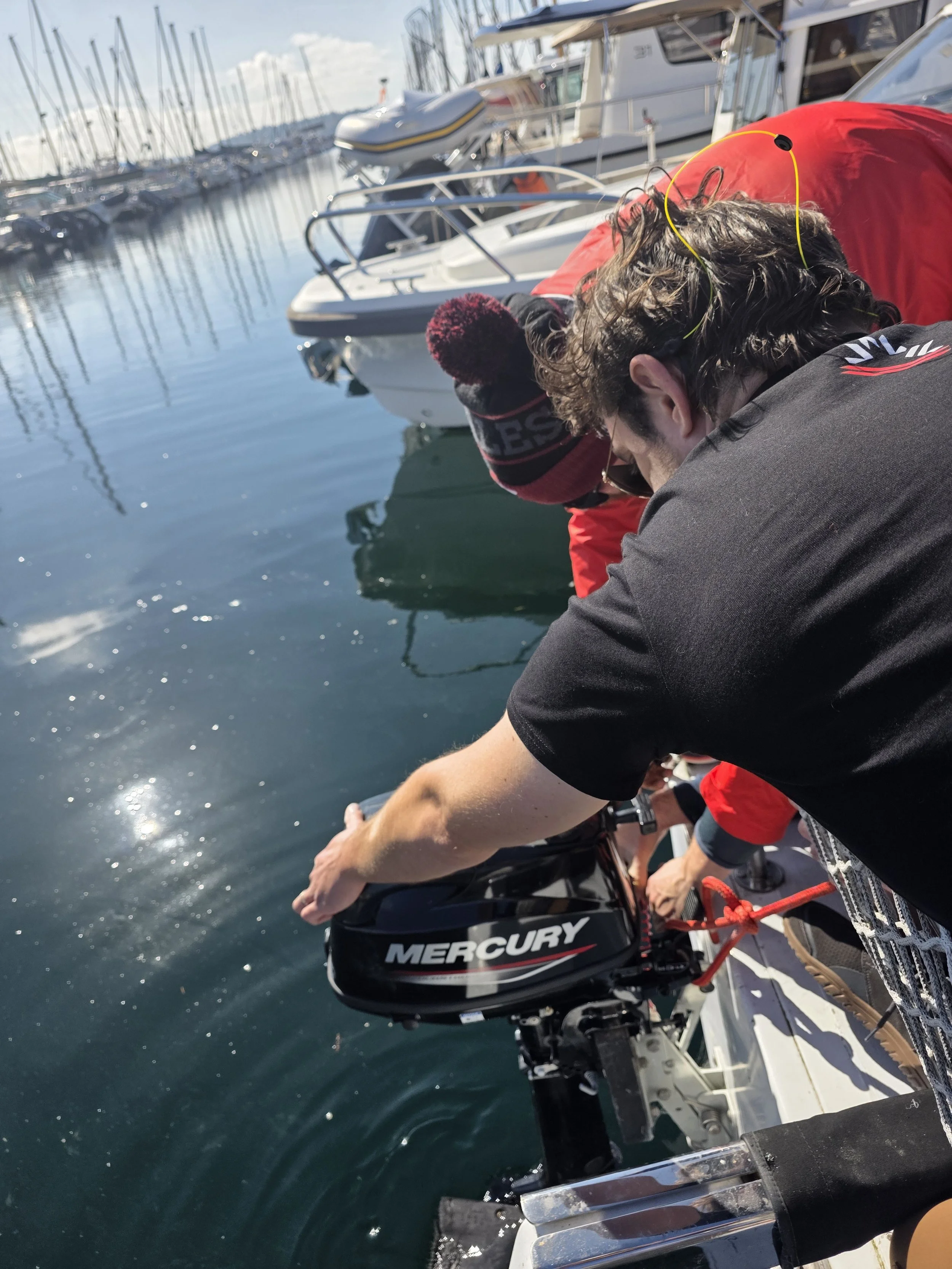
Getting the borrowed outboard onto the transom. It helps to have long arms.
Alex, Tim and I had toured the boat the week before with Jenny, but this was Geoff and Mike's first look. We took some time to go through the sails and give her a closer inspection. Between several like-new racing headsails and spinnakers and the mainsail we'd already seen, we figured there might be $5,000 in sails alone. That was exciting, but it also made us wonder whether we had a motivated seller or whether something was wrong. He'd seemed too busy to really engage with us, and we knew the moorage was expensive, so we hoped he just needed to be done with her. With time to spare before the surveyor arrived, Mike and I walked up for coffee and ran into our surveyor on the way back.
There was of course paperwork to fill out, and our surveyor walked us through the survey process. Then it was time to get underway! The marina was narrow. I don't think we'd properly appreciated our fairways at Shilshole until then, so we backed out of the slip with extra care. Mike took the helm, with Tim working the outboard throttle separately for extra control. Geoff grabbed a boat hook, I grabbed a roving fender, and Alex kept lookout. The steering was very sluggish. Even with the tiller hard over and decent speed, she was slow to turn, and a bit of wind and current didn't help. Geoff and I ran back and forth between bow and stern, Geoff pushing off with the boat hook and me ready to fend off any contact. Thanks to some quick reactions from Geoff and Mike, it took about a 25-point turn, but we got her out of the slip and pointed out of the marina.
The boat was only a little longer than Raven, but even at full throttle we couldn't get much past 2 knots. With a 2 pm haul-out appointment to make, we raised the main. There was decent wind, and we got her up to 3 to 3.5 knots. It was an incredibly beautiful fall day on the Sound. The mountain was out, and we even spotted a cargo ship with modern sails heading out to sea.
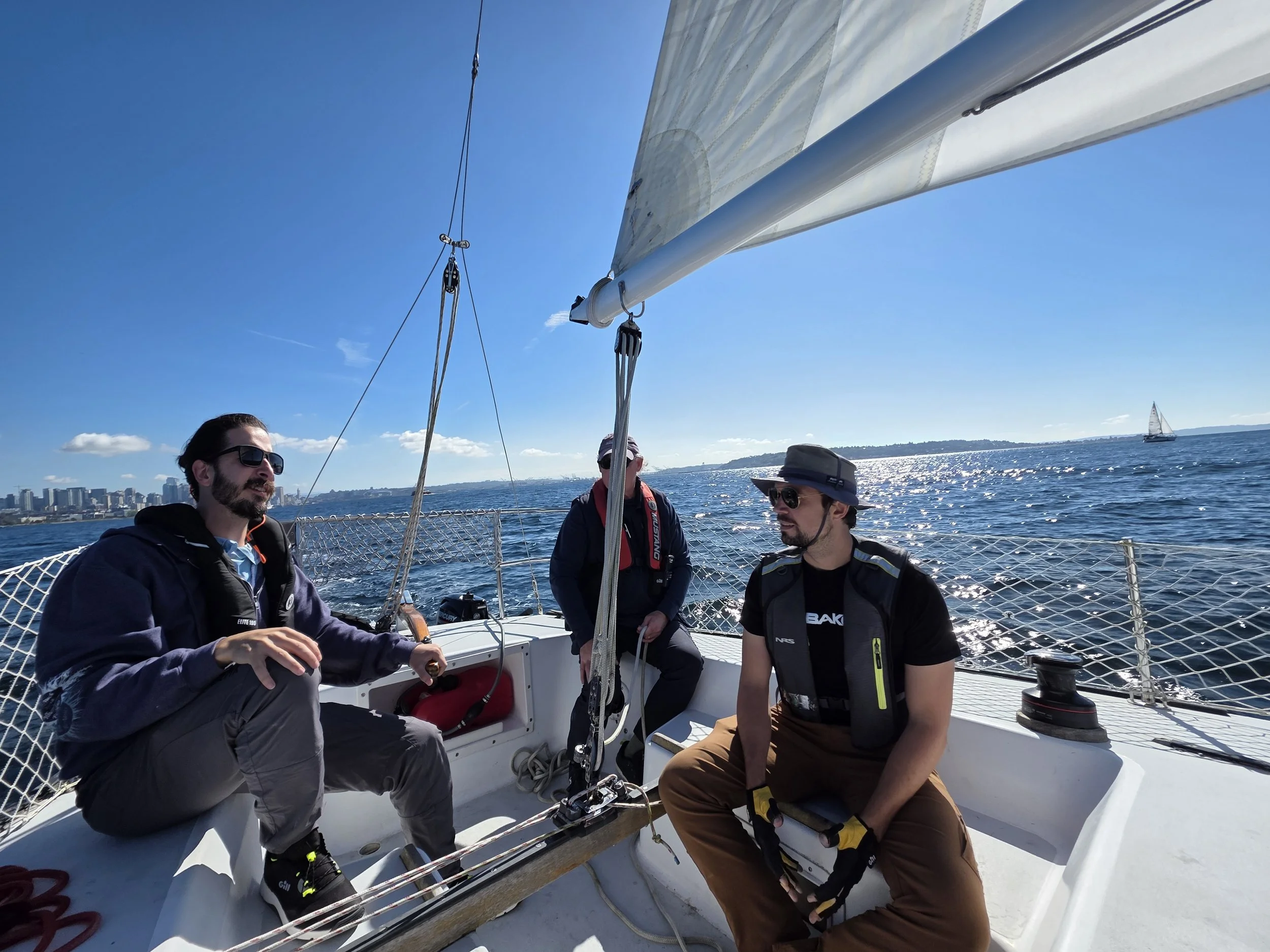
Under sail and running late, on a perfect fall day on the Sound.
While our surveyor tapped his way around the boat, checking the hull with his ball-peen hammer, we started to get a feel for her. Those of us who took the helm felt more weather helm than the conditions warranted. At one point I had the tiller hard over just trying to steer a straight line, and she kept turning the other way. Still, I think we were starting to fall a little in love with her. We'd been debating a crew of five or six, and the roomy cockpit felt like it could work for either. She moved through the water well, and the beautiful day probably didn't hurt. We were definitely running late, though. Fortunately, our surveyor knew the folks at the haul-out and let them know we were on our way.
We arrived about 2:30pm, and it was fascinating to watch. Tim drove us into the lift bay, and the yard crew caught the boat with boat hooks and started lifting the straps under her. Once she was securely cradled, we climbed out over the bow and up a ladder, lined up on shore, and watched them hoist her the rest of the way. Then the whole lift rolled forward and they blocked her for stability.
That's when we got our first look at the bottom, and it was WILD. The growth and sea life clinging to the hull, keel and rudder was like nothing we'd ever seen. Apparently it was new to other people too, because some random guy at the yard wandered over to stare and take pictures. The yard crew scraped off the sea life with a metal plate and followed up with a pressure washer. That same guy picked off a few sea slugs and crabs, showed them to us, then ran them back to the water.
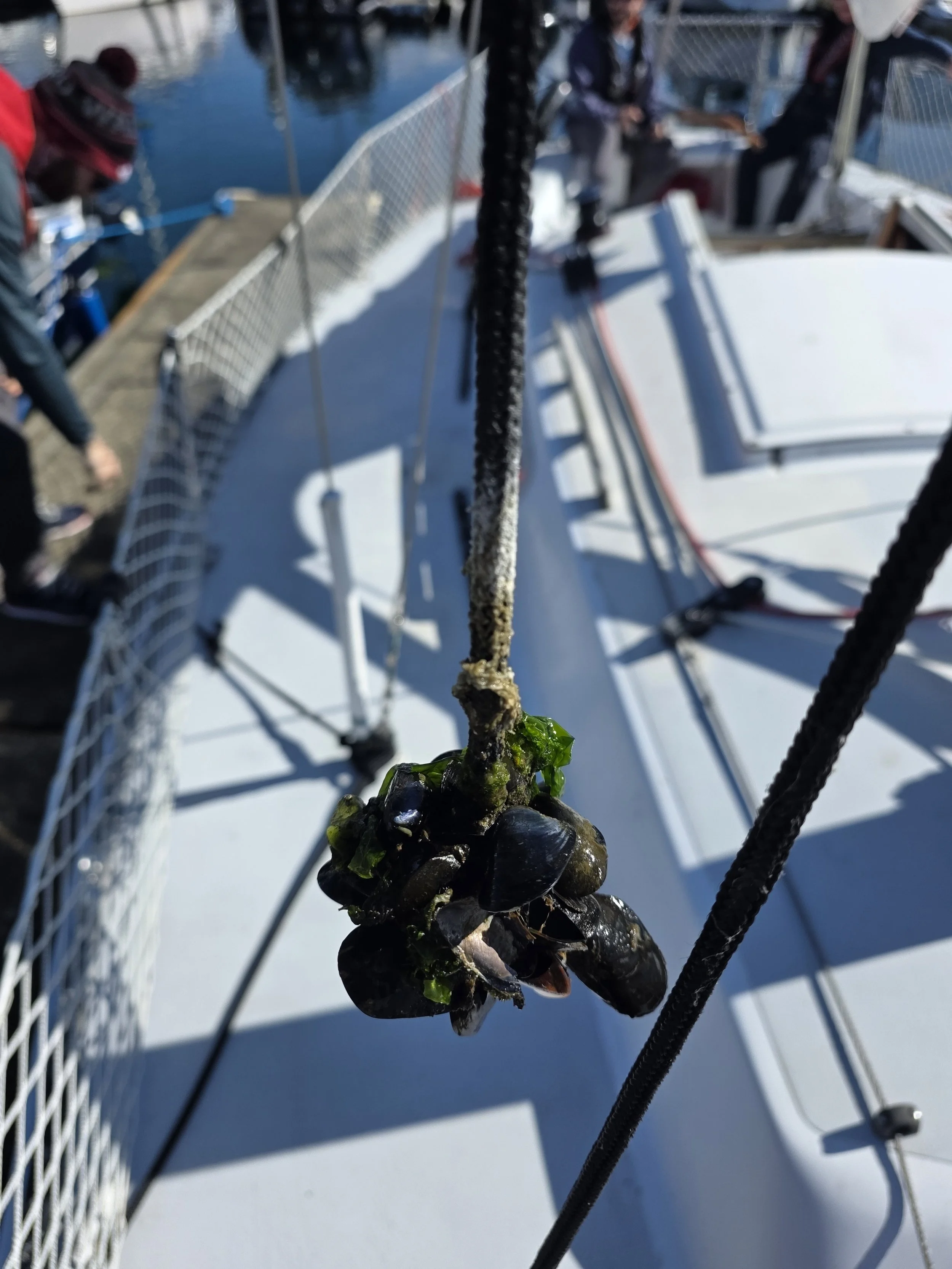
Not a good sign: mussels and weed growing on one of the boat's lines.
Our surveyor got back to work with his little hammer, tapping the hull, marking it with chalk and giving the rudder a few good kicks. It was tempting, and disorienting, to try to read his marks. Good thing? Bad thing? When he finished, he walked us through what he'd found, and it wasn't great. Some of the chalk marks just showed where the hull changes by design and so sounds different. Others marked places where the fiberglass had delaminated. Mike has some boat-building and fiberglass experience, so we talked through what a repair would take. Next, our surveyor points out a crack in the keel. As the lift carries the boat back toward the water, we can see the keel moving.
Back aboard, we left the yard, hoisted the main and hanked on the jib. With a clean bottom, we made good time back to the marina. On the way, our surveyor walked us through the rest of his findings. The delamination wasn't limited to the hull. There was significant delamination in the deck too, including structural areas under the winches and on the transom. The standing rigging was original to the boat, decades past the usual advice to replace it about every 15 years. And she was several hundred pounds overweight, a sign of water in the core.
Emotionally, it was a tough call for all of us. Intellectually, there was really no decision to make. This isn’t the boat for us. I'd gone into the survey wanting to see four things: hull integrity, keel integrity, the condition of the standing rigging and the steering. She failed three of the four, and the steering wasn't great either, even though nothing was specifically wrong with it.
It is still a beautiful day, so we try to enjoy the sail back, and the conversation turns to what we want and where to look next. Alex brought up a J/29 he'd found in Canada that had already done R2AK a couple of times and looked to be in much better shape. We also decide that Mike is a perfect sixth crew member for us.
By 9 p.m., Tim and I were back in the budget spreadsheet, running the numbers on the new boat. She doesn't have a proper head (the owners swapped it for a composting toilet), but even so, she'd need far fewer upgrades than the boat we'd surveyed that day. The day didn't quite go as planned, but we came away with a new crew member and a new boat to explore.
